Throughout both World Wars, Hamilton was considered a hub for manufacturing, training, fundraising, and recruitment for the Canadian Expeditionary Force (CEF). Hamilton is also intimately linked to France's battlefields: two regiments from the city, the Argyll and Sutherland Highlanders of Canada (Princess Louise’s) and the Royal Hamilton Light Infantry (Wentworth Regiment), fought at Vimy and in Normandy.

The Lorne Scots Regtiment parading down Barton Street East in Hamilton in 1941. Credit: Hamilton Public Library, Local History & Archives /
At the outbreak of the First World War, many Hamiltonians rushed to enlist. By October 1915, 10,000 men – almost 10% of the city’s population – joined the CEF, an extraordinary record. The Argyll and Sutherland Highlanders of Canada alone contributed 5,000 men and 145 officers. Many more regiments were created, including an artillery field battery for overseas service – the 40th, under the command of a Hamiltonian, Major Gordon Southam. By December 1915, the city managed to fundraise 1.2 million dollars for the war effort – roughly the equivalent of 25 million dollars today. Two training centres were also opened; an armament school and a facility for aerial fighting and artillery cooperation.
These impressive records were taken to new heights at the outbreak of the Second World War. The city refitted its manufacturing industry for wartime production, devoting much time and effort to crafting aircraft components for the Lancaster and Mosquito bombers. Training once again took on importance: in June 1941, the city opened the Canadian Army Trades School, the only of its kind in the country, to offer training in all forms of mechanical, electrical and woodworking trades. Recruitment continued unabated; by 1941, the city had exceeded its enlistment quotas. Many Hamiltonians enlisted in the Royal Hamilton Light Infantry and participated in the tragic Dieppe raid in August 1942. Perhaps the city’s most impressive record throughout the war, however, remained its ability to fundraise large amounts of money. By the end of hostilities, city residents raised a staggering 500 million dollars – the equivalent of roughly 7 billion dollars today!
Hamilton’s impressive war effort extended also into the air. In 1940, an airport facility was constructed just outside the city, housing the no. 10 Elementary Flying and No. 33 Air Navigation Schools. The airport expanded after the war and became a permanent fixture. Today, the John C. Munro International Airport houses the Canadian Warplane Heritage Museum. The museum holds dozens of Second World War and Cold War era aircraft, including only one of two airworthy Lancasters left in the world.
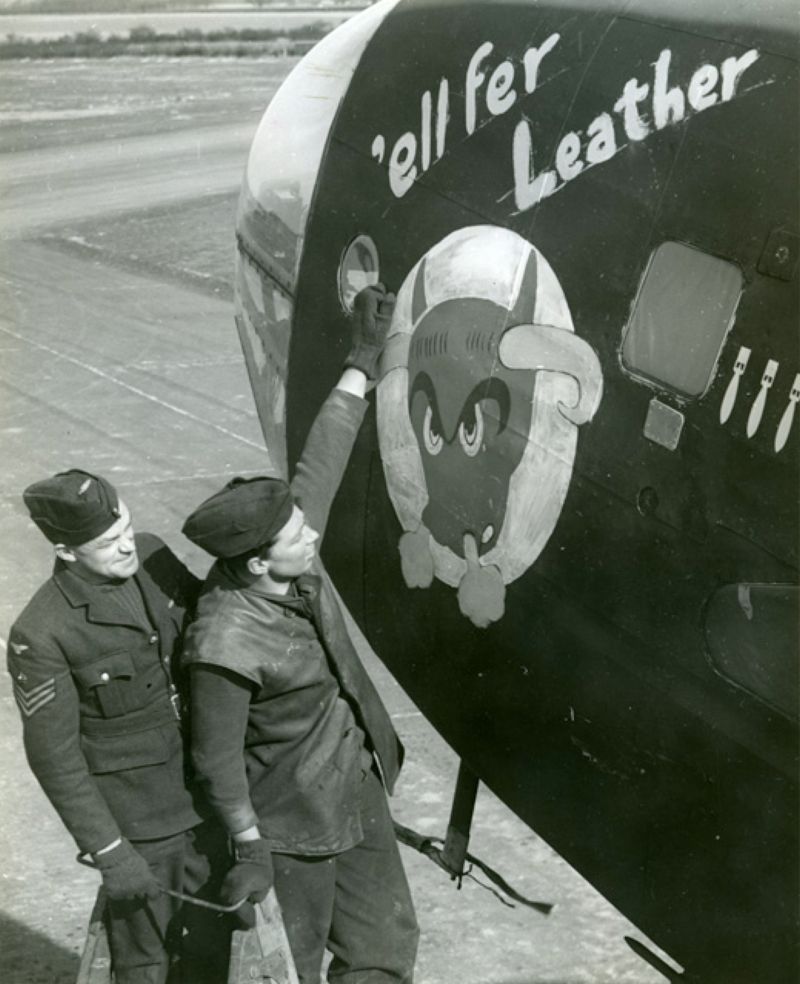
Two soldiers from the 150 Hamilton Tiger Squadron admiring "Ell fer Leather" in 1944. Credit: Hamilton Public Library, Local History & Archives /
Sources:
1) http://www.bankofcanada.ca/rates/related/inflation-calculator/
2) Houghton, Margaret. Hamilton at War: On the Home Front (Burlington, ON: North Shore Publishing, 2005).
3) McMaster University, “Your Child, Your Home, Your Loved Ones”: Hamilton During the Second World War.” http://pw20c.mcmaster.ca/case-study/your-child-your-home-your-loved-ones-hamilton-during-second-world-war
4) McMaster University: ““Everybody from Grandma to the little tot in the schoolroom ...”: The City of Hamilton during World War I.” http://pw20c.mcmaster.ca/case-study/everybody-grandma-little-tot-schoolroom-city-hamilton-during-world-war-i
5) http://www.warplane.com/about-cwhm/museum-history.aspx
Featured Image: Credit: Hamilton Public Library, Local History & Archives /